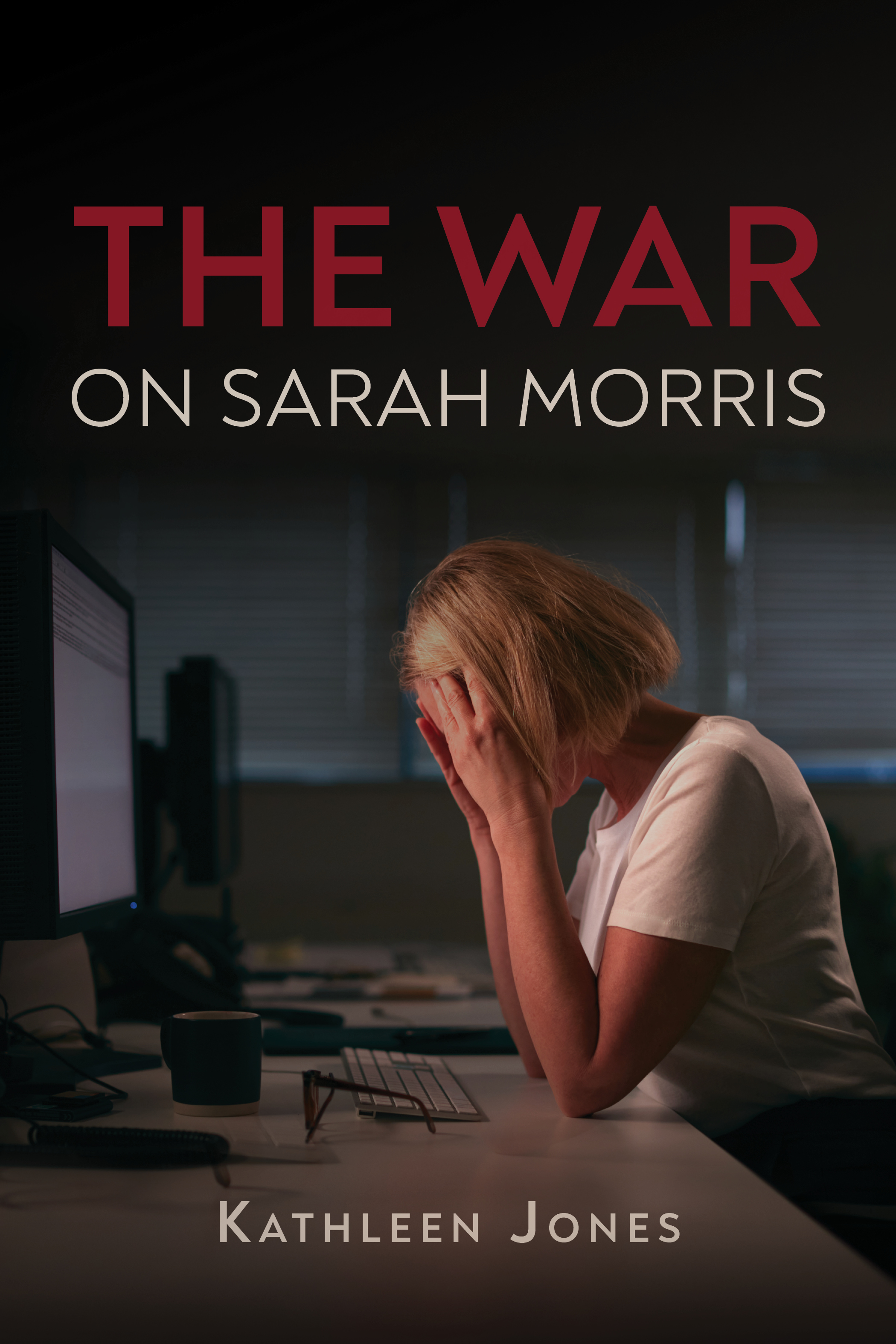
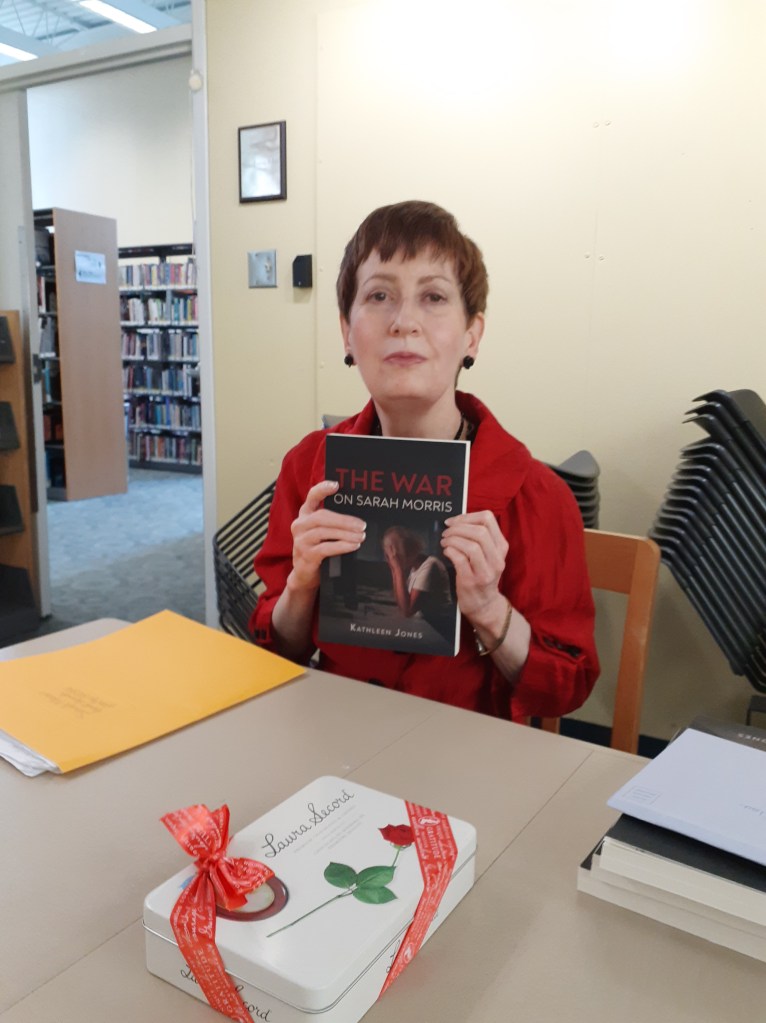
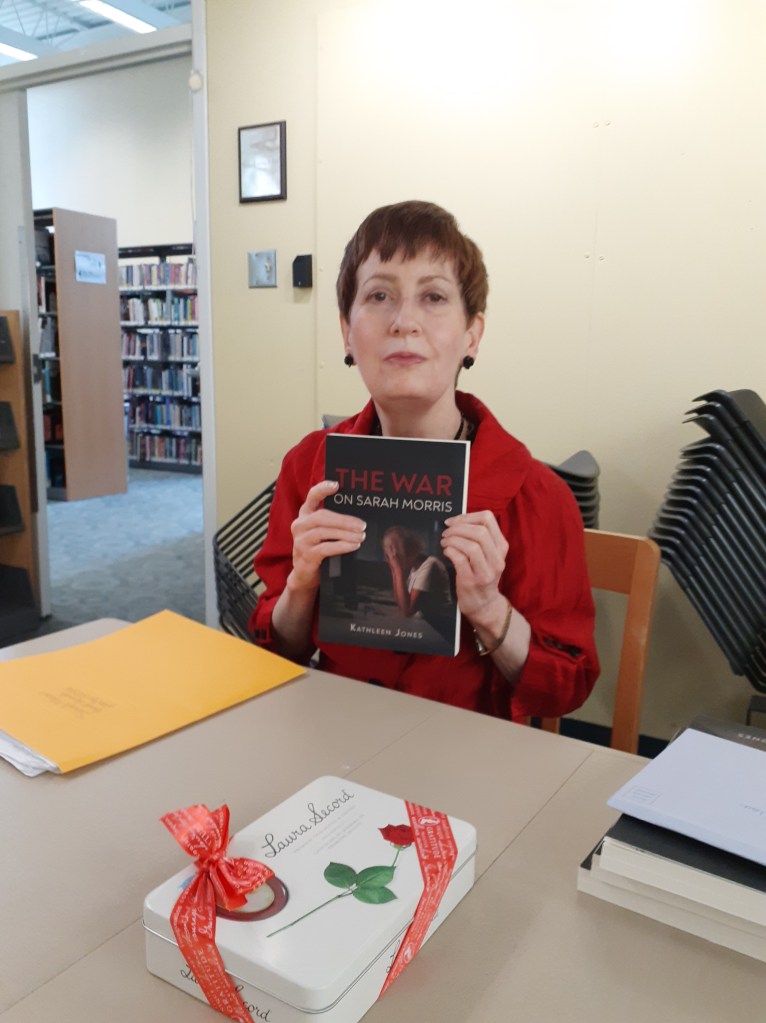
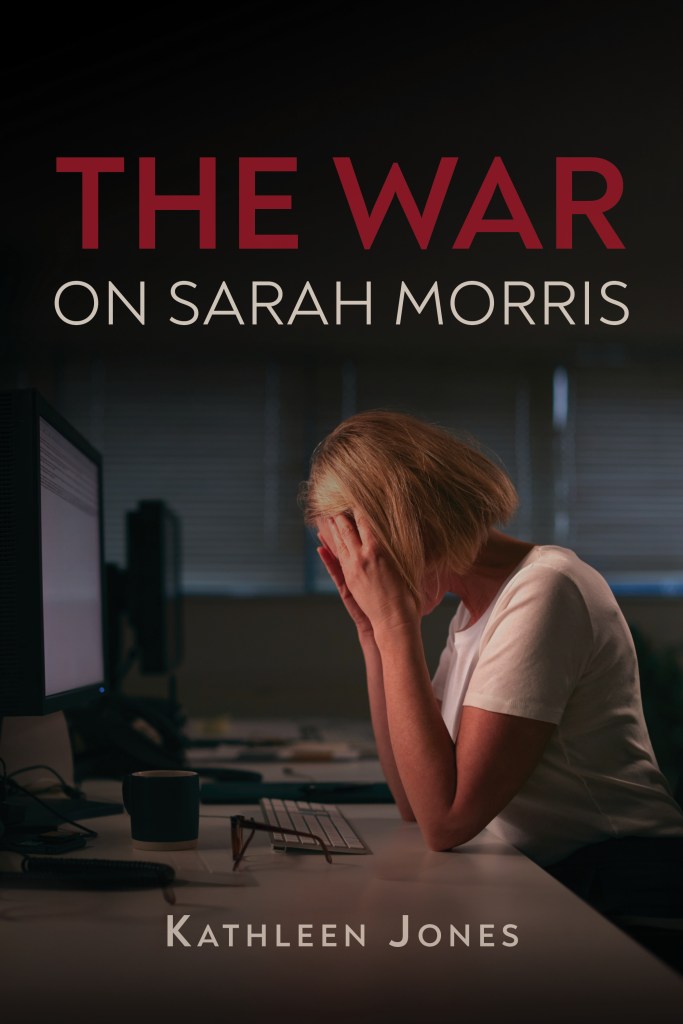
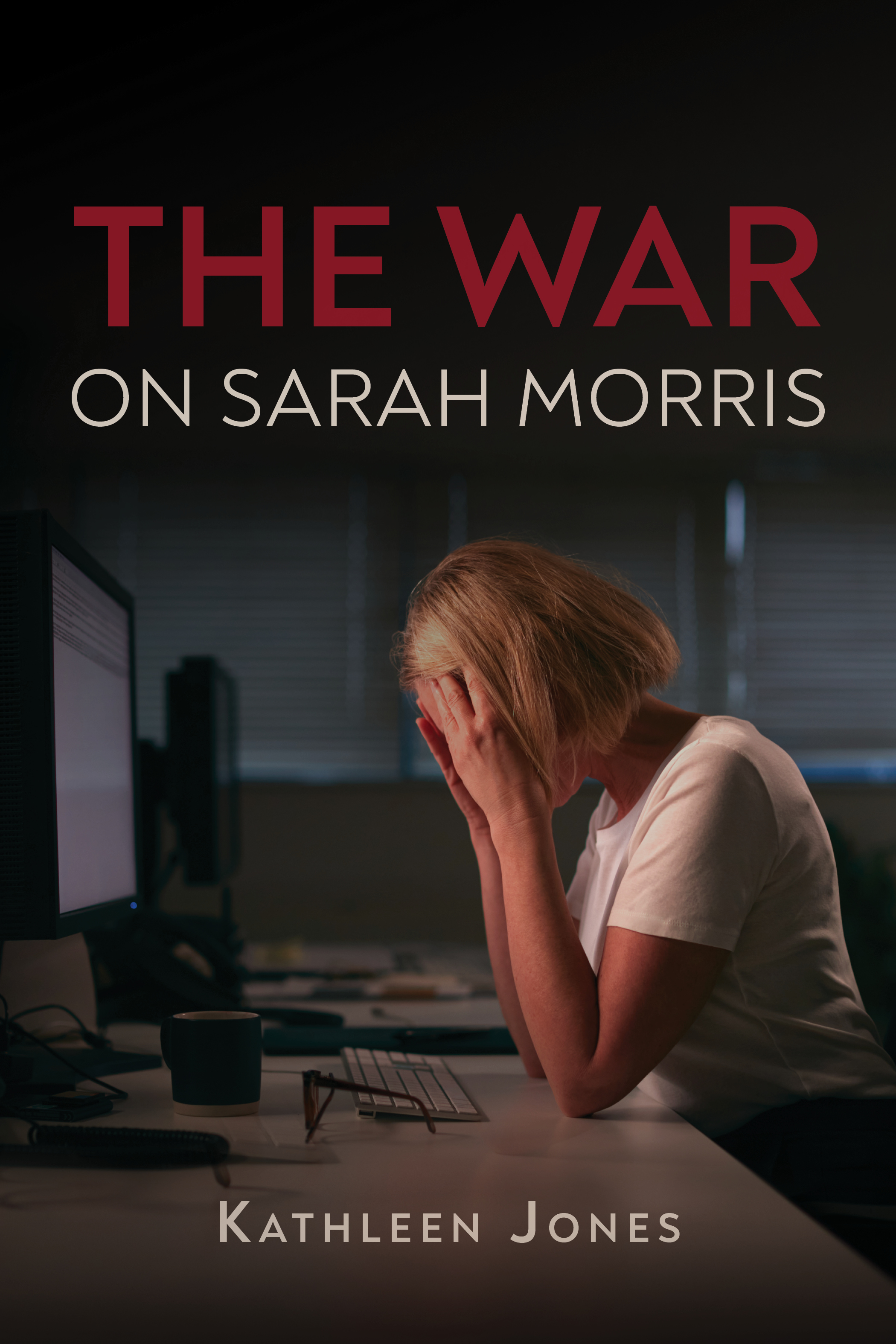
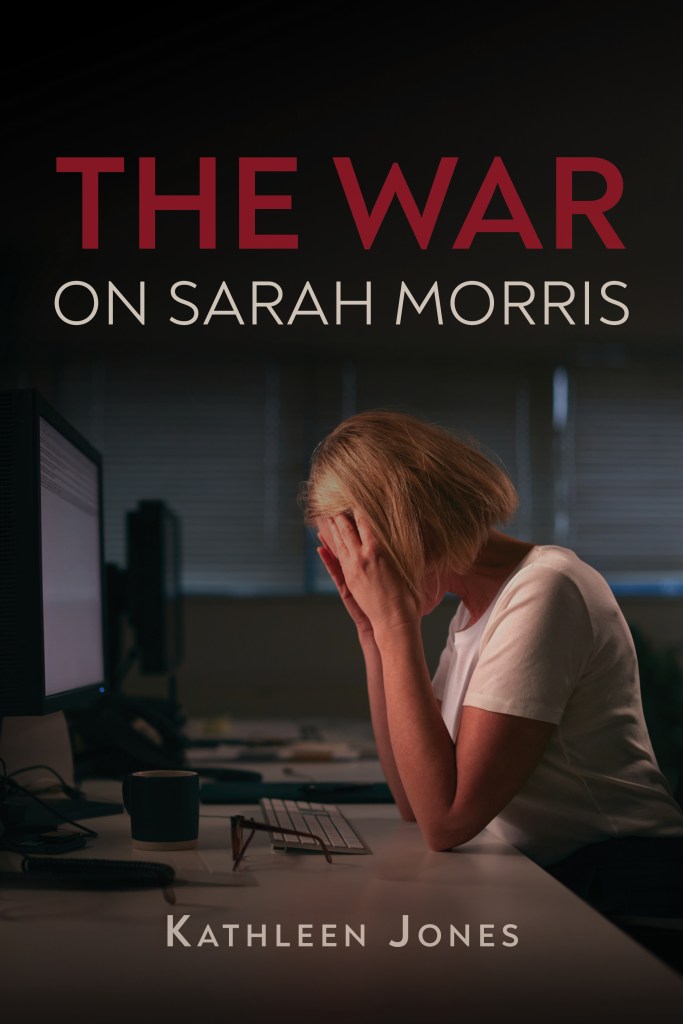
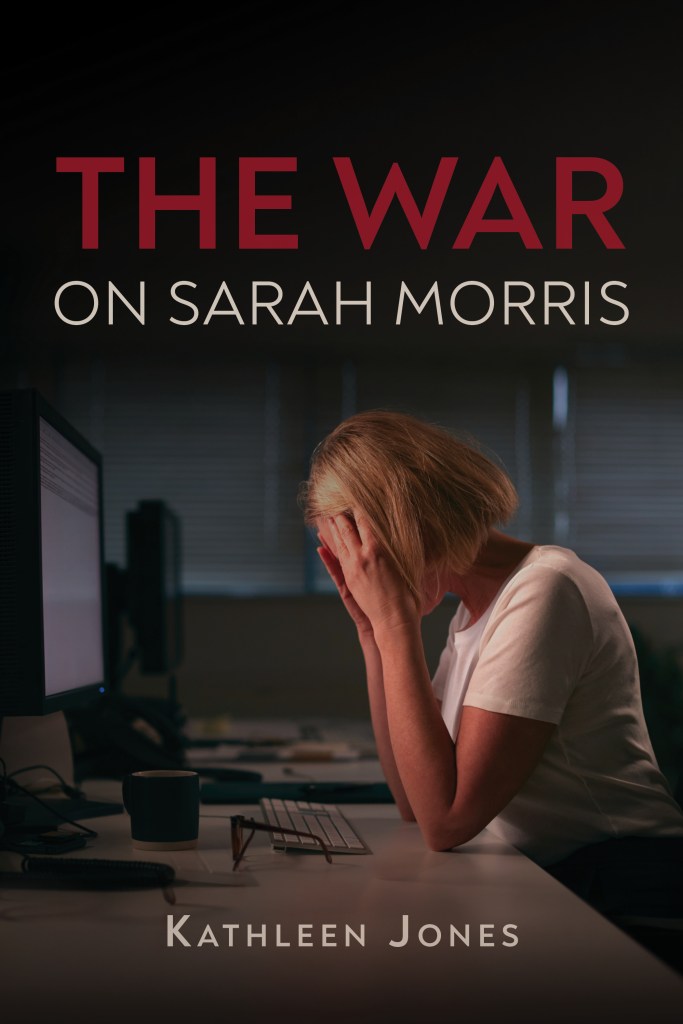
Excerpt from “The War on Sarah Morris” by Kathleen Jones

Copyright 2024 by Kathleen Jones-Lepidas

Published by Legacy Book Press, April 2024

CHAPTER ONE

Effective October 4, 2010, the roles of Sarah Morris, Caleb Elliott, and Ramona Duvall will be changing…

Bullshit! This company isn’t “changing the roles” of Caleb, Ramona, and me; it’s taking our roles away, destroying our livelihoods, our very careers. It’s taking away the work we were hired to do—editing authors’ manuscripts, turning them into polished books—and farming it out to freelancers, a nameless and faceless army with no connection or loyalty to this company. Thanks a lot.

I stare at the email on my computer screen, my mind suddenly flooded with questions.

Why on earth did the company do this to me? Maybe it’s my age. I’m forty-nine, practically a wizened old geezer as far as the business world is concerned. Or maybe I’ve just been at this company too long—twenty-one years, to be exact—and they’re sick to death of me. Or maybe the reason is a lot more personal; my boss, Gillian, has never really liked me. And nine years of slaving under her dictatorship, swallowing her mean-spirited comments while trying, over and over and over again, to please her, haven’t changed her mind, not one iota.

Hmm, do I still even have a job at all? I scan the email, trying hard not to panic. Oh, yes, it looks like I do: Caleb, Ramona, and I will be “processing” documents. Meanwhile, the two women who have been doing all the “processing” for our department will be leaving the company next Friday “to pursue exciting new opportunities.” Exciting new opportunities? On this planet? The last time I watched the news, millions of people were pounding the pavement, looking for work. And Quill Pen Press will save a ton of money once these employees have been kicked out of their jobs and their work has been dumped on Caleb, Ramona, and me.

I want to bash my fist through the screen, strangle the smug words in front of me.

…job titles will not be changing…

Translation: We get to keep our now-empty job titles. From now on, the three of us will be called “editors,” but we will no longer be real editors, just glorified data entry clerks with a fancy name. From now on, the three of us will be spending our days doing hours and hours of mindless, soul-sucking drudgery, pulling data off the Internet, formatting it into documents, tagging the documents. The ugly truth is, we’re being demoted, demoted by a cowardly and sneaky company that doesn’t have the guts to tell us what’s really going on. A company that no longer allows us to edit books, a company that no longer values our minds, our skills, our ideas, our knowledge. A company that no longer allows us to think at work. A company that no longer gives a shit about us.

Right now, I feel so hurt and angry and betrayed, I want to scream.

Farther down, toward the bottom of the screen, the news gets even worse:

Derek Witowsky will continue in his role as Manuscript Editor, working with authors…

Translation: Derek and the nameless and faceless freelance editors will be the only people who will be allowed to edit books at Quill Pen Press.

Of course Derek will continue in his role. He was always “smarter” than the rest of us editors, never failing to point out our mistakes to Gillian (even though we were too polite to point out his), forcing his way of doing things on us (even though the way we had been doing things worked perfectly well), shooting down our ideas at department meetings. Derek has always been the boss’s “pet.” She wouldn’t dream of demoting someone as wonderful as him.

Gillian Martin will continue in her role as Head of Editorial.

Of course she will. Gillian has always been brilliant at promoting her own selfish interests. A political animal through and through, she’s a whiz at bullying subordinates, quick to point out their tiniest, most insignificant errors while withholding praise for outstanding work. Unless, of course, the subordinate’s name happens to be Derek Witowsky, in which case the rules are entirely different. Obviously, Gillian—who had considerable input into the decisions behind this email, collaborating with the other managers in an endless string of meetings behind closed doors—cast the three unlucky editors working for her aside to protect her own job and the career of her precious mentee. And it’s obvious that Gillian didn’t think my own career was worth protecting.

All employees are invited to an Information Session in the boardroom at 10:00 a.m. today. We will explain our new corporate strategy and answer your questions. Coffee and donuts will be served.

Coffee and donuts? Big deal. I glance at my watch. It’s almost 10:00 now. Around me, dozens of employees, their faces full of worry and fear, their loud voices blending into dozens of conversations, are spilling into the hallway, anxiously awaiting their fate in the boardroom. Screw it. I’m not going.

Sighing, I turn back to the computer screen, glowing coldly and harshly at me, and start to close the CEO’s email. Then a string of words—somehow I missed them—leaps out at me from the first paragraph:

Quill Pen Press will be transitioning to meet the more challenging marketplace of the 21st century…

Translation: The company is making these drastic changes because it’s losing a lot of money in this economy, a horrible economy full of unemployed people struggling to stay afloat. And unemployed people who are struggling can’t afford the luxury of snapping up the latest novels, biographies, how-to books, or anything else this company publishes.

I pause, my hand still clutching the mouse, take a deep breath, and try to calm down. I still have a job. And I’m taking this way too personally. What’s happening to me is also happening to some of my coworkers. It’s all about money: the worldwide economy is in the toilet, and the company is trying to stay afloat. It has to lay off staff and reassign the work to the remaining employees just to survive.

I loosen my grip on the mouse and look away from the computer screen, trying to blink the blurriness out of my eyes. By now, the office has emptied out, save for a few stragglers. I should join them, rush down to the info session.

But I don’t. I can’t. I have to find out what’s really going on. I have to speak to Gillian. Now.

I head down the hall toward Gillian’s office, knowing that she rarely bothers to show up at these boring info things, so there’s a very good chance I’ll find her there.

Her office door is closed, thank God. But my heart starts to pound.

I just have to calm down. And there’s no reason to be scared. The volume of short stories I edited a few months ago is selling well; it’s even earned several five-star reviews on Amazon. Gillian seems to be happy with my work; not long ago, she gave me a glowing performance review. Okay, she did keep Derek in a cushy job, but maybe that’s just common, subconscious, garden-variety sexism on her part.

My heart stops pounding. I knock softly on the door.

No answer.

Before I can knock again, the door flies open. There she is, tall, big-boned, plumpish, and mid-forty-ish, dressed in a flamboyant royal purple wrap dress, glaring down at me with her brilliant blue eyes.

Suddenly, I feel underdressed in my black 1940s wool crepe peplum jacket and knee-length camel wool flannel pencil skirt, my brown hair styled in a boring, chin-length bob.

Brushing her dark, glossy, shoulder-length hair away from her face, she rasps, “There’s an important information session in the boardroom right now.”

“I know,” I begin in a shaky voice as I try to pick out the right words. “I have to talk—”

“You must take these meetings a lot more seriously, Sarah. It’s your job to go to them.”

If these meetings are so “important,” then why aren’t you at this meeting, Gillian?

“Why did you demote me, Gillian? Why?”

Oh, my God, I said it! I actually said it! No lame attempt at small talk, just a bald, angry accusation.

Gillian is speechless. For a moment, she stares at me with a blank expression. Then she beckons me into her office and shuts the door.

She sinks down on the thick, luxurious black leather recliner behind her gigantic desk, cluttered with paper, books, manuscripts, paperclips, and other flotsam and jetsam, and I seat myself on the smaller, less comfortable chair opposite her.

“Look,” she begins in a calm voice, “you weren’t demoted. You have the same salary, the same job title.”

The same job title but not the same job.

“Then why can’t I do the work of a real editor anymore? Why do I have to spend all my time on tagging documents, on cutting and pasting data? That’s not editing, Gillian. It’s data entry work.”

Gillian sighs, exasperated. “Is that why you’re not at the info session?” She furrows her brow. “Look, this wasn’t my idea.”

“But didn’t you have some input?” No answer. “Weren’t you happy with my job performance? Did I do something wrong? Please tell me.”

“I would have told you if you had done something wrong,” Gillian responds, shaking her head. “Besides, I gave you a really good performance review just a month ago. Don’t you remember?”

She gave me a fabulous review! Maybe she had nothing to do with my demotion. Still…something doesn’t quite add up.

“You didn’t change Derek’s job,” I blurt out, deliberately brushing off her words.

“I had to keep somebody.” Gillian’s voice is rougher, spiked by impatience. “The company hasn’t been doing well since the recession started a couple of years ago, and it needed to reorganize. That’s why your job—why some employees’ jobs—were changed.”

“But how does the company save money by taking my responsibilities away, Gillian? They still have to pay freelancers to do the work.”

Gillian pauses. It’s obvious that she has run out of answers. “I don’t know, to tell you the truth,” she mutters.

She doesn’t know? Is she saying that she had nothing to do with the decision to demote me?

“Is there any chance I could move back into my old job if the company starts making money again?” I probably could. After all, Gillian was happy with my work in the past.

She sighs. “Why don’t you give this new job a chance? You might end up liking it.”

Translation: If you try out this new job and like it, great…

“And you’re welcome to drop by any time to chat,” she smiles. “My door is always open.”

Translation: …but if you don’t like your new job, you can discuss it with me.

And maybe I can talk her into giving me my old job back. “Okay, Gillian,” I reply, returning her smile. “I’ll give it a try.” I rise from the chair, tension draining from my chest, and stroll out of the office, gently closing the door behind me.

Looks like I was wrong about Gillian. She really does care about me, after all; she even invited me to drop in on her whenever I want to. And if I’m not happy with my new job, I’ll just speak to her.

I return to my desk—now surrounded by a sea of empty desks— sit down and reach into my blue nylon bag for something to eat. It’s empty, except for a stale-looking apple, its skin a faded red covered in brown specks. I bite into it anyway.

Okay, maybe Gillian will help me, maybe she won’t. Either way, I won’t be stuck in this new job forever. This recession will be over with by next year. And once the economy picks up and Quill Pen starts making money again, I might be able to return to my old job. If not, I’ll look for something else. I just have to hang in there.

Want to read more? Purchase your copy of The War on Sarah Morris. Available in paperback and ebook from:


And Another 5-Star Review for The War on Sarah Morris!


(Posted by Susan Turbie on Goodreads on May 5, 2024)

5 Stars

After years of loyal service, Sarah Morris, an experienced, highly competent, middle-aged senior editor with a publishing firm, gets demoted and increasingly sidelined and exploited. The novel deals with her struggles to regain control of her career and her destiny, amid the constant downsizing, outsourcing and backstabbing that is corporate life today. 

As someone who has been through a similar experience to that of the eponymous heroine, (a woman approaching 50 made redundant after years of loyal service), I felt a great deal of empathy for Sarah. That said, she did sometimes get on my nerves: she’s a little paranoid, with something of a persecution mania (note the number of times she refers to what’s happening to her – and many other employees – as “sabotage” and “against her”). The very title of the book is telling: The War against Sarah Morris. But it’s not about her, it’s not personal – which is of course both the point and the tragedy of the situation: it’s completely impersonal, it’s nothing you’ve done wrong, but at the same time, all the things you did right – your experience, competence, loyalty, sense of professional ethics and conscientiousness, dedication – count for nothing in the end. It’s all about bottom line.

The fact that there’s a single plot strand, few characters and that most of the action takes place in the workplace make the novel’s universe seem a little narrow and oppressive at times. But it’s intentional: the author cleverly (and uncomfortably) captures that stifling atmosphere of relentless stress, anguish and uncertainty of having an unrewarding job where you’re undervalued by your bosses and are completely dispensable: the lack of control, being at the mercy of the ruthless, soul-crushing corporate machine with its endless rounds of takeovers, lay-offs “restructuring”; the armies of technocrats who blind you with corporate management jargon, always banging on about streamlining and bottom lines, downsizing and outsourcing organizations to within an inch of their life. That’s what it’s like when you’re stuck in a job you hate, can’t find a new one and can’t just chuck it all in because you have bills to pay and a mortgage: there is no escape, no relief, no respite.

The plot is nicely paced and it reads well. As I said earlier, I occasionally wanted to shake Sarah and yell at her to stand up for herself more: she’s a bit of a doormat, way too trusting, and something of a glutton for punishment (why oh why would she agree to organize a leaving do for her narcissistic sociopath of a boss?!) That said, her passivity and lack of self-esteem are party explained by the few glimpses we see of her personal life: her parents are hyper-critical and overbearing, and while her husband’s basically a nice enough guy, he’s not hugely supportive of Sarah’s plans to regain control of her career and life. 

But despite her flaws, Sarah is very believable and sympathetic, and after everything she’s been through, she still manages to be something of an idealist. And that’s why the reader is rooting for her, along with all the other victims of rapacious capitalism and the gig economy. Her journey will resonate vividly – if uncomfortably – with anyone who’s ever been made redundant, or had a petty, tyrannical, pathologically ambitious boss, and the way she navigates the treacherous waters of corporate life, eventually to rise again to reshape her destiny will inspire and give hope. 

Yet Another 5-Star Review for The War on Sarah Morris!

(Posted by Tasha Hutchison on Goodreads on April 20, 2024)

5 Stars

Prepare to be captivated by Kathleen Jones in her latest book, The War on Sarah Morris. From the moment you delve into the pages of this wonderfully crafted thriller, you are swept into a world of intrigue, danger, and moral dilemmas that will keep you on the edge of your seat until the very last page.

As a protagonist, Sarah is both compelling and relatable, navigating a web of deceit and betrayal with courage and determination. Her journey is not only a thrilling ride through the twists and turns of a complex plot but also a deeply emotional exploration of resilience in the face of adversity.

What truly sets The War on Sarah Morris apart is its exploration of timely and relevant themes. Through Sarah’s experiences, Jones tackles issues of power, corruption, and the blurred lines between right and wrong with nuance and insight. In doing so, she not only entertains but also challenges readers to question their own beliefs and assumptions about justice and morality. A must-read for fans of thrillers and anyone who appreciates a story that stays with you long after you’ve turned the final page.

Another Rave Review for “The War on Sarah Morris”

Midwest Book Review’s Small Press Bookwatch’s Review of The War on Sarah Morris

July 2024

(https://www.midwestbookreview.com/sbw/jul_24.htm)

The War on Sarah Morris
Kathleen Jones
Legacy Book Press
9798987482346, $17.99, PB, 245pp

https://www.amazon.com/War-Sarah-Morris-Kathleen-Jones/dp/B0CVQ28JYC

Synopsis: What happens when one day, without any warning, your secure corporate job suddenly becomes precarious? And all your professional duties are taken away, leaving you with nothing but repetitive, mind-numbing tasks?

Sarah Morris, is a 49-year-old editor at a Toronto publishing company who finds herself in this very predicament when Quill Pen Press, the company she has faithfully served for twenty-one years, undergoes a reorganization in the aftermath of the 2008 recession.

Concerned only with preserving her own cushy job, Sarah’s selfish boss gives all the company’s editing projects to freelancers and to a pet employee, unofficially demoting Sarah and two colleagues, who are now expected to spend their days tagging and formatting documents. When the two younger colleagues leave to pursue better opportunities, the boss dumps all their data entry tasks on Sarah and pressures her to complete an ever-growing mountain of work in less and less time, while taking away her right to paid overtime.

At first, Sarah is afraid to face the truth; she tells herself that she will get her old job back once the economy improves. But when the boss starts bullying her, she realizes that her company doesn’t have her best interests at heart and that she’s been pigeonholed into a dead-end job.

Critique: A story for our times, “The War on Sarah Morris” by author Kathleen Jones is an inherently compelling, deftly crafted, and showcases her narrative driven and impressively distinctive storytelling style as a novelist. A work of fiction that may well resonate with the reader’s real life experiences all too well, “The War on Sarah Morris” is especially and unreservedly recommended for community library Contemporary General Fiction collections. It should be noted for personal reading lists that “The War on Sarah Morris” is also readily available in a digital book format (Kindle, $5.99).

Editorial Note: For some thirty years, Kathleen Jones (https://kathleenjones.org) has been an editor for various Canadian book publishers. Today, Kathleen is a full-time author who writes for a number of popular book blogs. She also contributes monthly book reviews to Goodreads. She lives in Canada.


Author Interview: “The War on Sarah Morris” by Kathleen Jones

Published on The Reading Nook on July 4, 2024

About the Book:

What happens when one day, without any warning whatsoever, your secure corporate job suddenly becomes precarious? And all of your professional duties get taken away, leaving you with nothing but repetitive, mind-numbing tasks?

Sarah Morris, a 49-year-old editor at a Toronto book publisher, finds herself in this predicament when her company reorganizes after the 2008 Recession. Her boss Gillian Martin reassigns her editing duties, unofficially demoting Sarah and two of her co-workers, who are now expected to spend their days doing mind-numbing, repetitive tasks. When her co-workers leave the company to pursue better opportunities, Gillian dumps all of their data entry tasks on Sarah and pressures her to complete an ever-growing mountain of work in less and less time, while taking away her right to paid overtime. 

At first, Sarah is afraid to face the truth; she tells herself that she will get her old job back once the economy improves. But when Gillian starts bullying her, she realizes that her company doesn’t have her best interests at heart and that she’s been pigeonholed into a dead-end job.

Excerpt:

CHAPTER ONE 

Effective October 4, 2010, the roles of Sarah Morris, Caleb Elliott, and Ramona Duvall will be changing… 

Bullshit! This company isn’t “changing the roles” of Caleb, Ramona, and me; it’s taking our roles away, destroying our livelihoods, our very careers. It’s taking away the work we were hired to do—editing authors’ manuscripts, turning them into polished books—and farming it out to freelancers, a nameless and faceless army with no connection or loyalty to this company. Thanks a lot. 

I stare at the email on my computer screen, my mind suddenly flooded with questions. 

Why on earth did the company do this to me? Maybe it’s my age. I’m forty-nine, practically a wizened old geezer as far as the business world is concerned. Or maybe I’ve just been at this company too long—twenty-one years, to be exact—and they’re sick to death of me. Or maybe the reason is a lot more personal; my boss, Gillian, has never really liked me. And nine years of slaving under her dictatorship, swallowing her mean-spirited comments while trying, over and over and over again, to please her, haven’t changed her mind, not one iota. 

Hmm, do I still even have a job at all? I scan the email, trying hard not to panic. Oh, yes, it looks like I do: Caleb, Ramona, and I will be “processing” documents. Meanwhile, the two women who have been doing all the “processing” for our department will be leaving the company next Friday “to pursue exciting new opportunities.” Exciting new opportunities? On this planet? The last time I watched the news, millions of people were pounding the pavement, looking for work. And Quill Pen Press will save a ton of money once these employees have been kicked out of their jobs and their work has been dumped on Caleb, Ramona, and me. 

I want to bash my fist through the screen, strangle the smug words in front of me. 

…job titles will not be changing… 

Translation: We get to keep our now-empty job titles. From now on, the three of us will be called “editors,” but we will no longer be real editors, just glorified data entry clerks with a fancy name. From now on, the three of us will be spending our days doing hours and hours of mindless, soul-sucking drudgery, pulling data off the Internet, formatting it into documents, tagging the documents. The ugly truth is, we’re being demoted, demoted by a cowardly and sneaky company that doesn’t have the guts to tell us what’s really going on. A company that no longer allows us to edit books, a company that no longer values our minds, our skills, our ideas, our knowledge. A company that no longer allows us to think at work. A company that no longer gives a shit about us. 

Right now, I feel so hurt and angry and betrayed, I want to scream. 

Farther down, toward the bottom of the screen, the news gets even worse: 

Derek Witowsky will continue in his role as Manuscript Editor, working with authors… 

Translation: Derek and the nameless and faceless freelance editors will be the only people who will be allowed to edit books at Quill Pen Press. 

Of course Derek will continue in his role. He was always “smarter” than the rest of us editors, never failing to point out our mistakes to Gillian (even though we were too polite to point out his), forcing his way of doing things on us (even though the way we had been doing things worked perfectly well), shooting down our ideas at department meetings. Derek has always been the boss’s “pet.” She wouldn’t dream of demoting someone as wonderful as him. 

Gillian Martin will continue in her role as Head of Editorial. 

Of course she will. Gillian has always been brilliant at promoting her own selfish interests. A political animal through and through, she’s a whiz at bullying subordinates, quick to point out their tiniest, most insignificant errors while withholding praise for outstanding work. Unless, of course, the subordinate’s name happens to be Derek Witowsky, in which case the rules are entirely different. Obviously, Gillian—who had considerable input into the decisions behind this email, collaborating with the other managers in an endless string of meetings behind closed doors—cast the three unlucky editors working for her aside to protect her own job and the career of her precious mentee. And it’s obvious that Gillian didn’t think my own career was worth protecting. 

All employees are invited to an Information Session in the boardroom at 10:00 a.m. today. We will explain our new corporate strategy and answer your questions. Coffee and donuts will be served. 

Coffee and donuts? Big deal. I glance at my watch. It’s almost 10:00 now. Around me, dozens of employees, their faces full of worry and fear, their loud voices blending into dozens of conversations, are spilling into the hallway, anxiously awaiting their fate in the boardroom. Screw it. I’m not going. 

Sighing, I turn back to the computer screen, glowing coldly and harshly at me, and start to close the CEO’s email. Then a string of words—somehow I missed them—leaps out at me from the first paragraph: 

Quill Pen Press will be transitioning to meet the more challenging marketplace of the 21st century… 

Translation: The company is making these drastic changes because it’s losing a lot of money in this economy, a horrible economy full of unemployed people struggling to stay afloat. And unemployed people who are struggling can’t afford the luxury of snapping up the latest novels, biographies, how-to books, or anything else this company publishes. 

I pause, my hand still clutching the mouse, take a deep breath, and try to calm down. I still have a job. And I’m taking this way too personally. What’s happening to me is also happening to some of my coworkers. It’s all about money: the worldwide economy is in the toilet, and the company is trying to stay afloat. It has to lay off staff and reassign the work to the remaining employees just to survive. 

I loosen my grip on the mouse and look away from the comput- er screen, trying to blink the blurriness out of my eyes. By now, the office has emptied out, save for a few stragglers. I should join them, rush down to the info session. 

But I don’t. I can’t. I have to find out what’s really going on. I have to speak to Gillian. Now. 

I head down the hall toward Gillian’s office, knowing that she rarely bothers to show up at these boring info things, so there’s a very good chance I’ll find her there. 

Her office door is closed, thank God. But my heart starts to pound. 

I just have to calm down. And there’s no reason to be scared. The volume of short stories I edited a few months ago is selling well; it’s even earned several five-star reviews on Amazon. Gillian seems to be happy with my work; not long ago, she gave me a glowing performance review. Okay, she did keep Derek in a cushy job, but maybe that’s just common, subconscious, garden-variety sexism on her part. 

My heart stops pounding. I knock softly on the door.
No answer.

Before I can knock again, the door flies open. There she is, tall, big-boned, plumpish, and mid-fortyish, dressed in a flamboyant royal purple wrap dress, glaring down at me with her brilliant blue eyes. 

Suddenly, I feel underdressed in my black 1940s wool crepe peplum jacket and knee-length camel wool flannel pencil skirt, my brown hair styled in a boring, chin-length bob. 

Brushing her dark, glossy, shoulder-length hair away from her face, she rasps, “There’s an important information session in the boardroom right now.” 

“I know,” I begin in a shaky voice as I try to pick out the right words. “I have to talk—” 

“You must take these meetings a lot more seriously, Sarah. It’s your job to go to them.” 

If these meetings are so “important,” then why aren’t you at this meeting, Gillian? 

“Why did you demote me, Gillian? Why?” 

Oh, my God, I said it! I actually said it! No lame attempt at small talk, just a bald, angry accusation. 

Gillian is speechless. For a moment, she stares at me with a blank expression. Then she beckons me into her office and shuts the door. 

She sinks down on the thick, luxurious black leather recliner behind her gigantic desk, cluttered with paper, books, manuscripts, paperclips, and other flotsam and jetsam, and I seat myself on the smaller, less comfortable chair opposite her. 

“Look,” she begins in a calm voice, “you weren’t demoted. You have the same salary, the same job title.” 

The same job title but not the same job. 

“Then why can’t I do the work of a real editor anymore? Why do I have to spend all my time on tagging documents, on cutting and pasting data? That’s not editing, Gillian. It’s data entry work.” 

Gillian sighs, exasperated. “Is that why you’re not at the info session?” She furrows her brow. “Look, this wasn’t my idea.” 

“But didn’t you have some input?” No answer. “Weren’t you happy with my job performance? Did I do something wrong? Please tell me.” “I would have told you if you had done something wrong,” Gillian responds, shaking her head. “Besides, I gave you a really good performance review just a month ago. Don’t you remember?” She gave me a fabulous review! Maybe she had nothing to do with my demotion. Still…something doesn’t quite add up.

“You didn’t change Derek’s job,” I blurt out, deliberately brushing off her words.

“I had to keep somebody.” Gillian’s voice is rougher, spiked by impatience. “The company hasn’t been doing well since the recession started a couple of years ago, and it needed to reorganize. That’s why your job—why some employees’ jobs—were changed.” 

“But how does the company save money by taking my responsibilities away, Gillian? They still have to pay freelancers to do the work.” 

Gillian pauses. It’s obvious that she has run out of answers. “I don’t know, to tell you the truth,” she mutters. 

She doesn’t know? Is she saying that she had nothing to do with the decision to demote me? 

“Is there any chance I could move back into my old job if the company starts making money again?” I probably could. After all, Gillian was happy with my work in the past. 

She sighs. “Why don’t you give this new job a chance? You might end up liking it.” 

Translation: If you try out this new job and like it, great… 

“And you’re welcome to drop by any time to chat,” she smiles. “My door is always open.” 

Translation: …but if you don’t like your new job, you can discuss it with me. 

And maybe I can talk her into giving me my old job back. “Okay, Gillian,” I reply, returning her smile. “I’ll give it a try.” I rise from the chair, tension draining from my chest, and stroll out of the office, gently closing the door behind me.

Looks like I was wrong about Gillian. She really does care about me, after all; she even invited me to drop in on her whenever I want to. And if I’m not happy with my new job, I’ll just speak to her. I return to my desk—now surrounded by a sea of empty desks— sit down and reach into my blue nylon bag for something to eat. It’s empty, except for a stale-looking apple, its skin a faded red covered in brown specks. I bite into it anyway.

Okay, maybe Gillian will help me, maybe she won’t. Either way, 

I won’t be stuck in this new job forever. This recession will be over with by next year. And once the economy picks up and Quill Pen starts making money again, I might be able to return to my old job. If not, I’ll look for something else. I just have to hang in there. 

Copyright 2024 by Kathleen Jones-Lepidas

Author Interview:

1: Tell us a little about yourself and what got you in to writing?

For thirty (long) years, I toughed it out in the corporate world, chiefly as an editor for various Canadian book publishers. Sometimes, I had the opportunity to do work I enjoyed, but too often, I didn’t. Towards the end of my career, the type of work that interested and challenged me began to slip away, and I became less and less happy.

Then one day, I realized something: creative, out-of-the box thinkers like me don’t belong in the corporate world, and if I wanted “meaningful” work, I’d have to create it for myself.

That was when I decided to pursue the only work that I’d ever really wanted to do since I was a child: the work of a novelist! 


2: Do you have a favourite time and place where you write?

I like to write on the couch in my living room on quiet weekday afternoons.

3: Where do your ideas come from?

Most of my ideas come from my personal experiences and observations. Of course, I only use those elements as starting points; most of my writing is purely fictional.

4: Do you have a plan in your head of where the story is going before you start writing or do you let it carry you along as you go?

I start out with a simple idea, expand that idea into a plot, then flesh out the plot by writing a long, chapter by chapter outline. But I don’t always stick to the outline; instead, I add to it, change it, take out parts that don’t seem to be working. 

5: What genre are your books and what drew you to that genre?

My novels are too original and unconventional to fit neatly into single genres. For example, my first novel, Love Is the Punch Line, an offbeat, midlife romance set in the world of standup comedy, fits into two genres, romance and literary fiction. My new novel, The War on Sarah Morris, deals with a middle-aged woman’s struggle to stay employed in a toxic corporate environment. It also fits into a couple of genres: literary fiction and women’s fiction.


6: What dream cast would you like to see playing the characters in your latest book?

Amy Adams would be a great choice for the title character in The War on Sarah Morris. She’s such a talented and underrated actress!


7: Do you read much and if so who are your favourite authors?

I read almost every day! I read all types of books (fiction and non-fiction), magazines, newspapers, even websites. My favourite authors are Claire Messud, John Irving, Carol Shields, Margaret Atwood, Marilyn French, Miriam Toews, and Douglas Cole.

8: What book/s are you reading at present?

Right now, I’m enjoying Caliban and the Witch by Italian-American feminist Silvia Federici. The book deals with the experiences of women during the transition to capitalism from the late Middle Ages to the witch hunts. 


9: What is your favourite book and why?

My favourite book is Marilyn French’s novel The Women’s Room. I strongly identified with the main character’s struggle to carve out an independent life and identity.


10: What advice would you give for someone thinking about becoming a writer?

I would advise an aspiring writer to do the following: read well-written books; research the book business (publishing, sales, etc.) online; set up a social media platform (including an author blog); network with other authors; hire a professional editor and a proofreader to polish your manuscript before you submit it to agents and book publishers.

11: What are the best Social Media Sites for people to find out about you and your work?

Author site: https://kathleenjones.org

Goodreads: www.goodreads.com/author/show/17498110.Kathleen_Jones

LibraryThing: www.librarything.com/profile/Kathleen.Jones

Twitter: https://twitter.com/joneslepidas

Facebook: www.facebook.com/kathleen.lepidas

LinkedIn: www.linkedin.com/in/kathleen-jones-lepidas-csc

BookBub: www.bookbub.com/profile/kathleen-jones-3d442fae-1cd5-4404-be1b-cdf1ee8309f5


About the Author:

Kathleen Jones was born in Windsor, Ontario, Canada and graduated from the University of Toronto with a degree in English literature. For thirty years, she toughed it out in the corporate world, chiefly as an editor for various Canadian book publishers. Sometimes, Kathleen had the opportunity to do work that she enjoyed, but too often, she didn’t. Towards the end of her career, the type of work that interested and challenged Kathleen began to slip away, and she became less and less happy.

Then one day, Kathleen realized something: creative, out-of-the box thinkers like her don’t belong in the corporate world, and if she wanted “meaningful” work, she would have to create it for herself.

That was when Kathleen decided to pursue the only work that she’d ever really wanted to do since she was a child: the work of a novelist!

Today, Kathleen is a full-time author who writes for a number of popular book blogs. She also contributes monthly book reviews to Goodreads. She lives in Toronto, Ontario, Canada.


Another 5-Star Review for The War on Sarah Morris!

(Posted by Douglas Cole on Amazon.com on April 12, 2024)

5 Stars

Nightmares in publishing!

Fans of stories about the behind-the-scenes of publishing (I’m thinking of some recent delights such as My Salinger Yearby Joanna Rakoff, or the classic The Devil Wears Prada) will want to go out and buy this book immediately! Told with humor, tenderness and insight, The War on Sarah Morris takes inside the world of publishing in Toronto. Like the earlier-mentioned predecessors, Kathleen Jones’ book is not without its gritty, sometimes cringy moments of work at the bottom! Low pay, little respect, capricious decisions from managers…it’s a true story of life in the publishing trenches as business models evolve or even devolve! The beauty is in the writing and the character of Sarah Morris who deals with adversity with intelligence and pluck! As the title indicates, it’s a war! But it’s not without its surprises, and Jones takes us through the journey offering examples of how to survive and thrive in the most brutal artistic business of all.

Review: The War on Sarah Morris by Kathleen Jones

(Reviewed by BigAl on BigAl’s Books and Pals on May 22, 2024: http://booksandpals.blogspot.com)

     4 Stars

Genre: Coming of Age

Description:

“ONE DAY, YOU’RE A VALUED EMPLOYEE OF THE COMPANY … THE NEXT DAY, YOU’RE BEING PUSHED OUT THE DOOR.

What happens when your secure corporate job suddenly becomes precarious? Book editor Sarah Morris finds herself in this predicament when the company she has served for twenty-one years is reorganized. Sarah’s boss gives all the company’s book editing projects to freelancers and a pet employee, unofficially demoting Sarah, who must spend her days tagging documents. And when Sarah’s boss starts bullying her, she realizes that she’s been pigeonholed into a dead-end job.”

Author:

“Kathleen Jones was born in Windsor, Ontario, Canada and graduated from the University of Toronto with a degree in English literature. For thirty years, she toughed it out in the corporate world, chiefly as an editor for various Canadian book publishers. Sometimes, Kathleen had the opportunity to do work that she enjoyed, but too often, she didn’t. Towards the end of her career, the type of work that interested and challenged Kathleen began to slip away, and she became less and less happy.

Then one day, Kathleen realized something: creative, out-of-the box thinkers like her don’t belong in the corporate world, and if she wanted “meaningful” work, she would have to create it for herself.

That was when Kathleen decided to pursue the only work that she’d ever really wanted to do since she was a child: the work of a novelist!

Today, Kathleen is a full-time author who writes for a number of popular book blogs. She also contributes monthly book reviews to Goodreads. She lives in Toronto, Ontario, Canada.”

For more, visit her website her website.

Appraisal:

I struggled to even decide what genre to indicate this book fit in. The small publisher that published this book describes themselves as specializing in non-fiction genres “such as memoir, autobiographical fiction, poetry, or a combination.” While I’ve never heard the term autobiographical fiction before and it seems like two words that contradict each other, what they mean by that is easy enough to figure out and based on the author’s biography this novel almost surely has some degree of that. But what I could be sure of is that while far from what we think of or the typical definition of a coming-of-age story, that description still seems to fit this one as the protagonist struggles with life’s changes and how to deal with them in the same way as a teen trying to move into adulthood might.

However, unlike a coming-of-age story, the ideal reader for this is probably a touch older. To really get into the story of Sarah Morris, I think a reader needs to be old enough to be somewhat established in their career, possibly seen and struggled with unanticipated changes, or at least observed others deal with that struggle. Those in this position will understand where Sarah is coming from and get sucked into the story, wondering how it is going to end.

Buy now from:            Amazon US        Amazon UK

Format/Typo Issues:

No significant issues

Rating: **** Four Stars

Reviewed by: BigAl

Approximate word count: 75-80,000 words

Bullied at Work? This Is Your Story

By Kathleen Jones

(Guest post written by Kathleen Jones and published on World of My Imagination on May 13, 2024: https://worldofmyimagination.com/bullied-at-work-this-is-your-story-by-kathleen-jones/)

(May 13, 2024 Nicole Pyles)

If you’ve been bullied at work, this is your story!
My new novel, The War on Sarah Morris, is fiction. And it’s also non-fiction. It deals with the real world, the world that you and I live in, a world that’s often harsh and unstable and unfriendly to a lot of working people.

On the surface, the central character, Sarah Morris, seems to have plenty of advantages: she’s middle-class, educated, employed in a professional job—she’s an editor at a book publishing company in Toronto—married, living in a swanky downtown condo. But when Sarah’s company, Quill Pen Press reorganizes in the wake of the 2008 recession, her world starts to crumble. Quill Pen demotes Sarah and most of the other editors at the company, forcing them to spend their days doing menial data entry work instead of editing books. A few months later, Sarah’s co-workers—who are younger than her—leave the company to pursue better opportunities. Alone and without allies, Sarah struggles to stay employed; among other things, she must deal with bullying bosses, backstabbing co-workers, a penny-pinching company. And a number of troubling real-world trends:

• Companies are replacing permanent, stable, middle-class jobs with poorly-paid, unstable contract employment and gig work. Many of these companies—at least before the pandemic—have enjoyed record profits. However, they have replaced countless permanent jobs with benefits with unstable jobs that lack benefits in order to pad their bottom lines. Sarah’s company, overly focused on the bottom line, tries to bully her out of a job without paying her any severance. Likewise, Sarah’s husband Steven, a computer programmer at a major bank, is fired from his job then rehired as a contract worker without the benefits he enjoyed as a bank employee.

• Age bias is prevalent. Middle-aged people, even well-educated people like Sarah, have trouble finding work. Despite her education, experience, and skills, Sarah has a hard time landing a new job because she’s over 50.

• Gender bias is far too common. Sarah loses job opportunities to less qualified and competent male employees. Her female boss, despite her gender, doesn’t like or respect women. Sarah’s male boss also disrespects women. Even worse, he talks down to Sarah and makes phony promises that he doesn’t intend to keep.

• Companies emotionally and psychologically abuse their employees. They demote good employees without cause to save money, make phony promises about job opportunities, dump heavy and unrealistic workloads on people and force them to work overtime without pay. All these nasty things happen to Sarah.

Precarious jobs, age bias, misogyny, bullying, emotional and psychological abuse. Why on earth did I write such an upbeat novel?

I wrote this novel because it’s my own story. And I wanted to tell the truth about the struggles of far too many working warriors in an increasingly cruel and ruthless working world. A lot of non-fiction books deal with this subject, but they’re dominated by cold facts and figures. Hardly any of them deal with the emotional fallout from this hard new world on the real people who work in it.

I hope my novel fills those empty spaces on the bookshelf, And I also hope that the story of a strong woman’s survival in the new tough world of work will inspire other people who are facing the same hardships.

“The War on Sarah Morris” was published by Legacy Book Press in April 2024. The paperback and ebook are available NOW from Amazon and Goodreads.

Kathleen Jones is a Toronto-based novelist who writes in multiple genres. Her first novel, Love Is the Punch Line, an offbeat, midlife romance set in the world of stand-up comedy, was published by Moonshine Cove in 2018. The book has received a number of favorable 4- and 5-star reviews on Amazon and Goodreads. Kathleen was actively involved in marketing and promoting her novel; among other things, she wrote guest posts for several book-related websites, hosted a book-launch party, was interviewed by a local newspaper (The North York Mirror), convinced several publications and book bloggers (The Midwest Book Review, The San Francisco Review of Books, etc.) to review her novel, conducted ebook giveaways (in return for reviews) on LibraryThing and Goodreads, landed consignment contracts with several local stores, and sold dozens of copies of her novel during book signings at local Indigo and Coles bookstores.

Author site: https://kathleenjones.org/
Goodreads: https://www.goodreads.com/author/show/17498110.Kathleen_Jones
LibraryThing: https://www.librarything.com/profile/Kathleen.Jones
Twitter: https://twitter.com/joneslepidas
Facebook: https://www.facebook.com/kathleen.lepidas
LinkedIn: https://www.linkedin.com/in/kathleen-jones-lepidas-csc/

The War on Sarah Morris Featured in Snowflakes in a Blizzard

(published in Snowflakes in a Blizzard on April 23, 2024: See https://snowflakesarise.wordpress.com)

THE BOOK: The War on Sarah Morris.

PUBLISHED IN: 2024.

THE AUTHOR:  Kathleen Jones.

THE EDITOR: Glenda MacFarlane (substantive and line editor), Marina Endicott (writing mentor), Allister Thompson (copy editor), Britanie Wilson (proofreader), Laura Boyle (cover designer).

THE PUBLISHER: Jodie Toohey (Legacy Book Press).

SUMMARY: In The War on Sarah Morris, a middle-aged woman struggles to survive in the cruel and ruthless corporate jungle.

 What happens when one day, without any warning, your secure corporate job suddenly becomes precarious? And all your professional duties get taken away, leaving you with nothing but repetitive, mind-numbing tasks?

Sarah Morris, a 49-year-old editor at a Toronto book publisher, finds herself in this predicament in October 2010, when Quill Pen Press, the company she has faithfully served for twenty-one years, undergoes a reorganization in the aftermath of the 2008 Recession. Concerned only with preserving her own cushy job, Gillian Martin, Sarah’s selfish boss, gives all of the company’s book editing projects to freelancers and to Derek Witowsky, her pet employee, unofficially demoting Sarah and two of her colleagues, who are now expected to spend their days tagging and formatting documents. When the two younger colleagues leave to pursue better opportunities, Gillian dumps all of their data entry tasks on Sarah and pressures her to complete an ever-growing mountain of work in less and less time, while taking away her right to paid overtime.

At first, Sarah is afraid to face the truth; she tells herself that she will get her old job back once the economy improves. But when Gillian starts bullying her, she realizes that her company doesn’t have her best interests at heart and that she’s been pigeonholed into a dead-end job.

THE BACK STORY: This novel, which took five years to write, was based on my own experiences, so I had the necessary insights to write it. I knew what it was like to work extra hours for no extra pay just to hold onto my job. I knew what disrespect and bullying from bosses felt like, the frustration of working in a tedious job far beneath my abilities without any possibility of promotion, the hopelessness of applying to companies that refuse to hire people over 40, no matter how smart, experienced, or educated they are. And I definitely knew what it was like to shoulder more and more work—more tedious work—without more time and resources to complete it, and to lose control over my time and my life.

WHY THIS TITLE? This title describes the central theme of the book: A corporation (like many modern corporations) is waging war on a long-term employee (Sarah Morris) by bullying her out of a job to save money (by replacing her with a cheaper contract employee).

WHY WOULD SOMEONE WANT TO READ IT?
 Because it deals with the world that many working people now live in. Because, all too often, the struggles of working people are invisible; most of them, like Sarah, are just trying to survive, and they don’t have the power to fight back against abusive employers. Because the public deserves to know the truth about abusive corporations that misrepresent themselves as caring, enlightened places to work.

REVIEW COMMENTS:

In this tense, funny novel, Sarah Morris, a 49 year-old editor, faces upheaval at the publishing company, Quill Pen Press, where she’s worked for the past 21 years. Though there is no change in her job title or pay, all of her job responsibilities are now different and she is forced to do overtime without pay for new daily tasks that she hates. With a recession ravaging hopes of economic stability, and finding herself her family’s sole income-earner following her husband’s dismissal from his banking job, Sarah must decide what steps she needs to take in her career to find her way back to being happy in the workplace. Does she dare a job search, as she puts it, “In middle age. In a crappy job market … that’s hostile to older people like me”?

Sarah exemplifies the emotional turmoil many feel when facing discontent in the workplace as Jones delves into self-doubt, the fear of starting over, and being complacent in a dead-end job. With wit, snark, and a striking sense of all-too-real realism, Jones writes a relatable and personable narrative about being pigeon-holed and feeling stuck with work that is no longer fulfilling or providing the space or opportunity for advancement. Exploring toxic work cultures, micromanagers, and workplace favoritism, The War on Sarah Morris is punchy and pained, outraged and comic, offering much that readers—especially women working in troubled industries—will find resonant. While set in 2011, the novel feels pointedly of the moment.

Jones convincingly captures the inner workings of a publisher and the ever-increasing responsibilities that fall onto lower level staffers, plus the indignities of a job search, from “biographical resumes” to pop-quiz writing assignments in job interviews. In this, Jones blends the engagingly dishy with sharp-elbowed analysis of power dynamics. Readers who have ever worked under tyrannical managers or for companies who only care about how much money is coming in will be impacted and feel a personal connection to Sarah’s struggle.

Takeaway: Sharp-elbowed novel of a woman facing a job hunt after 20 years in publishing.

Comparable Titles: Lisa Owens’s Not Working, Liz Talley’s Adulting.

Production grades
Cover: B+
Design and typography: A
Illustrations: N/A
Editing: A
Marketing copy: A

Booklife, Publisher’s Weekly, February 2024

THE WAR ON SARAH MORRIS by Kathleen Jones is a realistic and salient portrait of a 21st century working woman’s struggles in the corporate concrete jungle of Toronto.  The protagonist takes the reader on a psychological journey of twenty years of toiling at a publishing company that boils down to “long hours, unpaid overtime, bullying bosses, and backstabbing coworkers.” (p. 306) The story opens when Sarah receives an email about the company’s reorganization and list of employee layoffs. References to book proposals, marketing campaigns, book editing and tagging bring the book business to life. 

There’s great use of the classic Cassandra Situation, when Sarah tells everyone how bad the daily grind is at her office, but no one believes her.  I love the protagonist. She is believable, brave, resilient, and persistent. Despite being surrounded by so much negativity and disrespect, her actions, creativity, and fantasies move her forward to try and try again to cope with misery at work.  In the end, I found myself cheering for her as she comes to understand and save herself.  Jones creates a story that not only sheds light on the power of the human spirit, but also depicts serious social problems around agism, sexism, and economics in the workplace and job hunt, and how all of it spills over into the quality of life outside of work.  An inspiring read full of hard truths!  –D.S. Marquis, author, Of School and Women

A workplace drama filled with sass and comedic relief! I loved being in the mind of Sarah and rooting for her to end her misery at a dead-end job. You’ll love this glimpse inside a woman’s fight to save her career and herself. — C. D’Angelo, award-winning author, The Difference and The Visitor.

AUTHOR PROFILE Kathleen Jones is a Toronto-based novelist and former book editor who writes in multiple genres. Her first novel, Love Is the Punch Line, an offbeat, midlife romance set in the world of stand-up comedy, was published by Moonshine Cove in 2018. The book has received several favorable 4- and 5-star reviews on Amazon and Goodreads. She also writes frequent book reviews for Goodreads, Amazon, and LibraryThing. Kathleen lives in Toronto, Ontario, Canada.

AUTHOR COMMENTS: The novel talks about a problem faced by many women, a touchy, sensitive problem that few novels are willing to tackle: the struggle of women in the modern corporate world. The main character, Sarah Morris, is demoted (along with a couple of her co-workers) when the book publisher she works for is reorganized. One day, she’s a skilled, experienced editor who works on manuscripts with authors; the following day, she’s a glorified data entry clerk toiling in a dead-end job, doing repetitive, mind-numbing work, spending hours and hours cutting and pasting data, over and over again. Even worse, her new job comes with unwanted baggage that millions of working women have to cope with: long hours, heavy workloads, unpaid overtime, age discrimination, sexism, bullying from bosses, dirty games and lies, disrespect from co-workers, and stress, stress, stress. But Sarah, overwhelmed and seemingly powerless, hangs onto her dignity and humane values, and finds a way to fight back.

SAMPLE:

CHAPTER ONE

Effective October 4, 2010, the roles of Sarah Morris, Caleb Elliott, and Ramona Duvall will be changing…

Bullshit! This company isn’t “changing the roles” of Caleb, Ramona, and me; it’s taking our roles away, destroying our live- lihoods, our very careers. It’s taking away the work we were hired to do—editing authors’ manuscripts, turning them into polished books—and farming it out to freelancers, a nameless and faceless army with no connection or loyalty to this company. Thanks a lot.

I stare at the email on my computer screen, my mind suddenly flooded with questions.

Why on earth did the company do this to me? Maybe it’s my age. I’m forty-nine, practically a wizened old geezer as far as the business world is concerned. Or maybe I’ve just been at this com- pany too long—twenty-one years, to be exact—and they’re sick to death of me. Or maybe the reason is a lot more personal; my boss, Gillian, has never really liked me. And nine years of slaving under her dictatorship, swallowing her mean-spirited comments while trying, over and over and over again, to please her, haven’t changed her mind, not one iota.

Hmm, do I still even have a job at all? I scan the email, trying hard not to panic. Oh, yes, it looks like I do: Caleb, Ramona, and I will be “processing” documents. Meanwhile, the two women who have been doing all the “processing” for our department will be leaving the company next Friday “to pursue exciting new opportunities.” Exciting new opportunities? On this planet? The last time I watched the news, millions of people were pounding the pavement, looking for work. And Quill Pen Press will save a ton of money once these employees have been kicked out of their jobs and their work has been dumped on Caleb, Ramona, and me.

I want to bash my fist through the screen, strangle the smug words in front of me.

…job titles will not be changing…

Translation: We get to keep our now-empty job titles. From now on, the three of us will be called “editors,” but we will no longer be real editors, just glorified data entry clerks with a fancy name. From now on, the three of us will be spending our days doing hours and hours of mindless, soul-sucking drudgery, pulling data off the Internet, formatting it into documents, tagging the documents. The ugly truth is, we’re being demoted, demoted by a cowardly and sneaky company that doesn’t have the guts to tell us what’s really going on. A company that no longer allows us to edit books, a company that no longer values our minds, our skills, our ideas, our knowledge. A company that no longer allows us to think at work. A company that no longer gives a shit about us.

Right now, I feel so hurt and angry and betrayed, I want to scream.

Farther down, toward the bottom of the screen, the news gets even worse:

Derek Witowsky will continue in his role as Manuscript Editor, working with authors…

Translation: Derek and the nameless and faceless freelance editors will be the only people who will be allowed to edit books at Quill Pen Press.

Of course Derek will continue in his role. He was always “smarter” than the rest of us editors, never failing to point out our mistakes to Gillian (even though we were too polite to point out his), forcing his way of doing things on us (even though the way we had been doing things worked perfectly well), shooting down our ideas at department meetings. Derek has always been the boss’s “pet.” She wouldn’t dream of demoting someone as wonderful as him.

Gillian Martin will continue in her role as Head of Editorial.

Of course she will. Gillian has always been brilliant at pro-moting her own selfish interests. A political animal through and through, she’s a whiz at bullying subordinates, quick to point out their tiniest, most insignificant errors while withholding praise for outstanding work. Unless, of course, the subordinate’s name happens to be Derek Witowsky, in which case the rules are entirely different. Obviously, Gillian—who had considerable input into the decisions behind this email, collaborating with the other managers in an endless string of meetings behind closed doors—cast the three unlucky editors working for her aside to protect her own job and the career of her precious mentee. And it’s obvious that Gillian didn’t think my own career was worth protecting.

All employees are invited to an Information Session in the boardroom at 10:00 a.m. today. We will explain our new corporate strategy and answer your questions. Coffee and donuts will be served.

Coffee and donuts? Big deal. I glance at my watch. It’s almost 10:00 now. Around me, dozens of employees, their faces full of worry and fear, their loud voices blending into dozens of conver- sations, are spilling into the hallway, anxiously awaiting their fate in the boardroom. Screw it. I’m not going.

Sighing, I turn back to the computer screen, glowing coldly and harshly at me, and start to close the CEO’s email. Then a string of words—somehow I missed them—leaps out at me from the first paragraph:

Quill Pen Press will be transitioning to meet the more challenging marketplace of the 21st century.

Translation: The company is making these drastic changes because it’s losing a lot of money in this economy, a horrible economy full of unemployed people struggling to stay afloat. And unemployed people who are struggling can’t afford the luxury of snapping up the latest novels, biographies, how-to books, or anything else this company publishes.

I pause, my hand still clutching the mouse, take a deep breath, and try to calm down. I still have a job. And I’m taking this way too personally. What’s happening to me is also happening to some of my coworkers. It’s all about money: the worldwide economy is in the toilet, and the company is trying to stay afloat. It has to lay off staff and reassign the work to the remaining employees just to survive.

I loosen my grip on the mouse and look away from the comput- er screen, trying to blink the blurriness out of my eyes. By now, the office has emptied out, save for a few stragglers. I should join them, rush down to the info session.

But I don’t. I can’t. I have to find out what’s really going on. I have to speak to Gillian. Now.

I head down the hall toward Gillian’s office, knowing that she rarely bothers to show up at these boring info things, so there’s a very good chance I’ll find her there.

Her office door is closed, thank God. But my heart starts to pound.

I just have to calm down. And there’s no reason to be scared. The volume of short stories I edited a few months ago is selling well; it’s even earned several five-star reviews on Amazon. Gillian seems to be happy with my work; not long ago, she gave me a glowing performance review. Okay, she did keep Derek in a cushy job, but maybe that’s just common, subconscious, garden-variety sexism on her part.

My heart stops pounding. I knock softly on the door.

WHERE TO BUY IT: Amazon, Barnes & Noble

PRICE: $17.99 (trade paperback), $5.99 (ebook)

CONTACT THE AUTHOR

Kathleen Jones

Email: joneslepidas@bell.net

Author site: https://kathleenjones.org/

Twitter: https://twitter.com/joneslepidas

Facebook: https://www.facebook.com/kathleen.lepidas

LinkedIn: https://www.linkedin.com/in/kathleen-jones-lepidas-csc/

Posted on April 23, 2024Categories UncategorizedLeave a comment